
Top Office Water Dispenser Types for Global Buyers
Choosing an Office Water Dispenser is no longer a simple matter of selecting hot and cold functions. Global buyers now assess water quality, energy use, hygiene controls, installation limits, and long-term servicing. In a small office, a countertop unit may fit beside the printer. In a factory, a high-capacity plumbed-in dispenser may be more practical. The right choice depends on people, plumbing, climate, and daily demand.
The WHO and UNICEF Joint Monitoring Programme reported that 2.2 billion people lacked safely managed drinking water services in 2022. This finding highlights why reliable treatment and maintenance deserve more attention than appearance alone. Industry research from Grand View Research and Fortune Business Insights also identifies rising demand for filtration, purification, and convenient workplace hydration systems. Their market analyses point to growing interest in point-of-use dispensers, reverse-osmosis models, bottle-fed coolers, and connected units. However, market forecasts vary by region and definition. Buyers should treat projections as guidance, not certainty.
Safety comes first. Always check applicable certification requirements, filter replacement schedules, electrical compatibility, and local water conditions. A dispenser with ultraviolet treatment may sound advanced, but it cannot replace regular cleaning. That is easy to forget. This guide compares the leading Office Water Dispenser types for international purchasers. It considers capacity, operating cost, filtration performance, user experience, and service complexity. The goal is practical selection, not a perfect universal answer. Even a highly rated model can fail when spare filters are unavailable or staff ignore sanitation procedures.
Office Water Dispenser Basics and Selection Criteria
Top Office Water Dispenser Types for Global Buyers
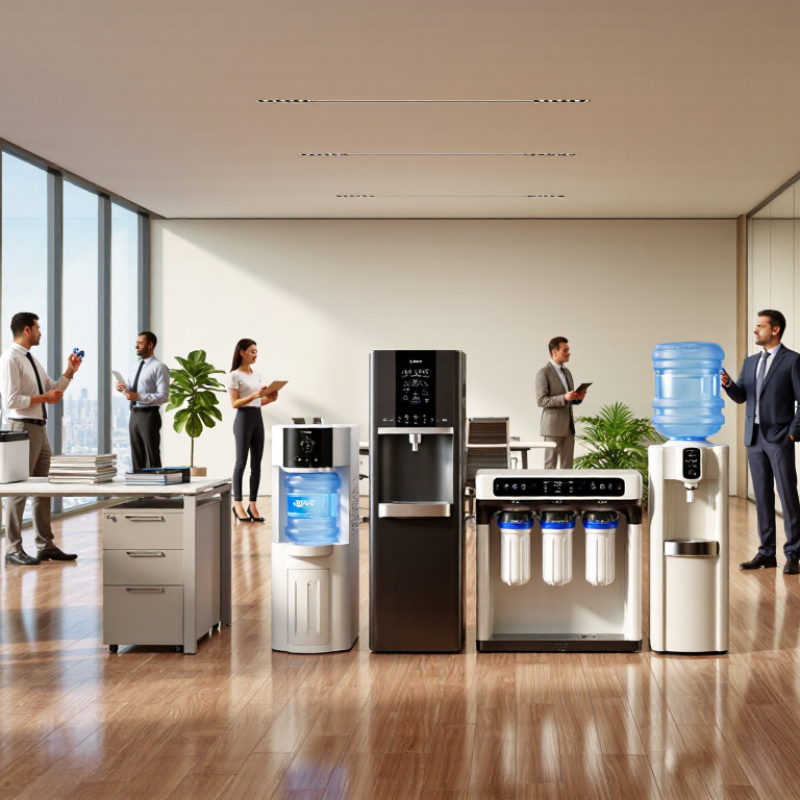
Office water dispensers usually fall into three practical types: point-of-use, bottle-fed, and countertop units. Point-of-use models connect to a water line and suit offices with stable plumbing. Bottle-fed units work where installation is difficult, but staff must manage storage and replacement schedules. Countertop dispensers save floor space. They may provide less output during busy periods.
Selection should begin with daily demand, not appearance. Count users, peak break times, and expected water consumption. A small team may need a compact unit, while a call center requires faster dispensing and a larger reservoir. Check filtration stages, replacement intervals, cooling speed, heating temperature, and spill protection. Noise matters in meeting rooms. So does cup clearance.
Water quality differs across regions, even within one city. Buyers should review local water reports and choose suitable filtration, such as sediment or carbon treatment. Ultraviolet treatment may support hygiene, but it does not replace regular cleaning. Ask about food-contact materials, electrical compatibility, safety controls, and local certification requirements. Maintenance access should be simple enough for routine staff checks.
A common mistake is choosing capacity without measuring service conditions. Bigger is not always better. A high-capacity unit can consume more energy and occupy valuable space. In practice, installation costs, filter availability, drainage needs, and service response often shape long-term value. The cheapest option may become expensive when parts are difficult to source. Evaluate the whole operating cycle.
Top Office Water Dispenser Types for Global Buyers - Office Water Dispenser Basics and Selection Criteria
| Dispenser Type | Water Supply | Common Filtration or Treatment | Typical Output and Capacity | Temperature Options | Installation Requirements | Main Advantages | Key Limitations | Best Office Application |
|---|---|---|---|---|---|---|---|---|
| Point-of-Use Bottleless Dispenser | Direct connection to a potable water line | Sediment and activated-carbon filtration; reverse osmosis or ultraviolet treatment may be added | Approximately 30–150 cups per hour, depending on cooling and heating power | Ambient, chilled, and hot water are commonly available | Nearby water connection, drainage where required, and electrical outlet | No bottle storage, consistent supply, reduced handling, and lower packaging waste | Requires professional installation, filter replacement, and suitable incoming water quality | Medium to large offices with stable occupancy and permanent premises |
| Top-Load Bottled Dispenser | Replaceable bottles, commonly 11–19 litres | Usually relies on treated bottled water; some units include a basic internal filter | Typically suitable for 10–40 users, depending on bottle availability and usage | Ambient, chilled, and hot water are widely offered | Level floor, electrical outlet, and sufficient clearance above the unit for bottle loading | Simple setup, broad availability, and easy deployment in rented offices | Heavy bottles require lifting; storage, delivery, and empty-bottle handling add logistics | Small offices, temporary workplaces, and locations without a nearby water line |
| Bottom-Load Bottled Dispenser | Replaceable bottles stored inside the lower cabinet | Treated bottled water; optional internal filtration varies by model | Typically suitable for 10–50 users, subject to bottle supply and recovery time | Ambient, chilled, and hot water are common configurations | Level floor, electrical outlet, and front clearance for bottle replacement | Easier bottle loading, cleaner appearance, and less overhead clearance than top-load designs | Pump and tubing require maintenance; bottled-water transport and storage remain necessary | Reception areas, staff kitchens, and offices where user convenience is important |
| Countertop Water Dispenser | Bottle-fed reservoir or direct connection to a water line | Activated carbon, sediment filtration, or reverse osmosis depending on configuration | Approximately 10–80 cups per hour; smaller reservoir than floor-standing units | Ambient and chilled; hot water is available on selected models | Strong, level countertop, electrical outlet, and clearance for ventilation | Space-saving, lightweight, and suitable for locations with limited floor area | Limited output, occupies counter space, and may require frequent refilling | Small teams, meeting rooms, compact pantries, and satellite offices |
| Under-Sink Filtered Water System with Faucet | Direct connection to the cold-water supply | Sediment and carbon filters; reverse osmosis may be used where lower dissolved solids are required | Good continuous ambient supply; chilled or hot output requires an additional module | Normally ambient; optional connected chiller or heater | Cabinet space, water connection, faucet opening, and access for filter servicing | Minimal visual footprint, convenient for kitchens, and no bottle handling | Usually does not provide chilled or hot water without extra equipment | Office kitchens and small workplaces that mainly need filtered ambient water |
| Atmospheric Water Generator | Moisture extracted from indoor air | Air filtration, mineralization, activated carbon, and ultraviolet treatment may be included | Often approximately 10–30 litres per day, highly dependent on temperature and relative humidity | Ambient and chilled; hot water depends on the design | Electrical outlet, adequate ventilation, and indoor humidity suitable for production | Reduces dependence on delivered bottles and can operate where water infrastructure is limited | Higher energy use, slower production, and performance varies substantially by climate | Specialty applications, remote facilities, and sustainability-focused installations |