Choosing a reliable Camping Tarp supplier requires more than comparing factory prices. Global buyers must examine fabric quality, coating performance, stitching, packaging, and export experience. A tarp can look excellent in photographs, yet fail after one night of heavy rain. That difference matters.
Andrew Skurka, a respected lightweight backpacking expert, says, “The best gear is the gear that you already own.” His view reminds buyers to focus on practical value, not impressive specifications alone. For a Camping Tarp, practical value may include a waterproof rating, reinforced guy points, rust-resistant eyelets, and stable performance under changing weather. These details become visible during real use. Wet ground. Strong wind. Repeated folding.
This guide presents China’s top ten Camping Tarp suppliers for global buyers. The selection considers manufacturing capability, material choices, customization support, quality-control procedures, minimum order quantities, and communication reliability. Some suppliers may offer excellent pricing but weaker documentation. Others may provide advanced fabrics while requiring larger orders. That trade-off deserves attention.
No ranking is perfect. Supplier information can change, and factory claims still require verification. Buyers should request samples, inspect seam sealing, confirm test reports, and clarify Incoterms before placing substantial orders. A small sample order may reveal problems that a polished catalog hides. It may also slow the purchasing schedule. Still, careful checking usually costs less than replacing thousands of defective tarps.
The companies below are intended as a practical starting point for outdoor brands, distributors, retailers, and project purchasers seeking dependable Chinese manufacturing partners. Reliability is not promised by a name alone. It is earned through evidence.
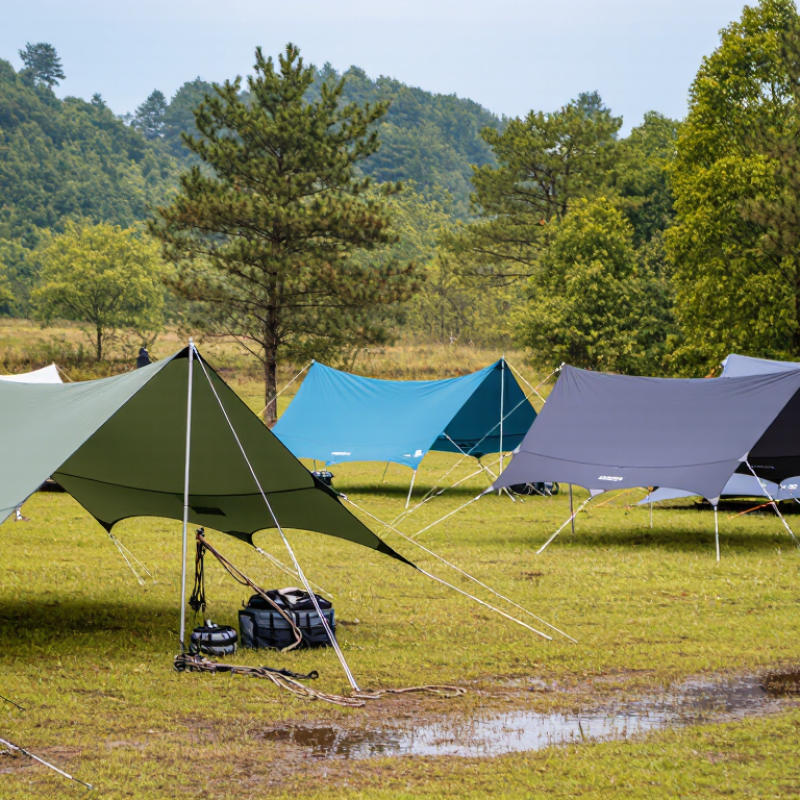
For global buyers, camping tarp fabric weight affects packability, abrasion resistance, and weather performance. A 210D polyester tarp is light and easy to carry. It suits weekend shelters, backpacking, and mild conditions. A 420D fabric offers a stronger balance for family camping. The 600D option feels tougher under repeated folding, rocky ground, and windy setups. However, heavier fabric also increases bulk and transport costs.
GSM means grams per square meter. It helps compare material weight more accurately than denier alone. A high-denier fabric may still have modest GSM if its yarn construction is efficient. Buyers should check both figures. A 210D tarp near 100 GSM may pack differently from another 210D tarp near 160 GSM. Small differences matter inside a crowded vehicle.
Waterproof ratings usually use hydrostatic head measurements in millimeters. For example, 1,500 mm indicates stronger water resistance than 800 mm. Yet coating quality, seam sealing, and stitching remain critical. A 600D tarp can still leak through needle holes. I have seen specifications look impressive while untreated seams failed during steady rain. Ask for laboratory reports, fabric samples, and seam photographs before placing a large order. Do not judge durability by thickness alone. Performance depends on the complete construction.
This chart compares common coated-polyester camping tarp constructions. GSM indicates fabric weight, while waterproof rating refers to hydrostatic head measured in millimetres. Higher denier and GSM generally improve abrasion resistance and durability, but coating quality, seam construction, and finish also affect real-world performance. Typical GSM ranges are approximately 100–150 for 210D, 150–220 for 300D, 220–300 for 420D, and 300–450 for 600D fabrics.
China’s camping tarp sector is closely connected to HS 6306 trade data. This customs heading commonly covers tents, awnings, sails, and other textile camping goods. Classification can vary by product design, fabric, and customs interpretation. Buyers should verify the exact HS code with a qualified customs broker.
Trade records show a wide export structure. Large coastal factories often handle coated polyester, ripstop fabric, aluminum hardware, and final packing under one roof. Smaller suppliers may specialize in stitching, waterproof seams, or private-label production. This creates flexible sourcing, but quality levels are not uniform.
Look closely.
A useful supplier review should compare export history, product specifications, inspection records, and shipment consistency. Ask for fabric weight, hydrostatic pressure, seam-tape details, fire-treatment information, and packed dimensions. A sample should remain outdoors for several hours, not only pass a clean indoor inspection.
HS 6306 data can reveal destination patterns, seasonal demand, and shipment frequency. However, trade databases may combine different products under one code. The picture is useful, but not perfect. Some records also reflect trading companies rather than actual manufacturers, which can confuse factory evaluations.
Experienced buyers usually connect customs data with factory audits and independent product testing. This approach helps identify suppliers that understand overseas packaging, documentation, and repeat-order control. A low unit price may hide thicker cartons, higher defect rates, or inconsistent color batches. That part deserves more attention.
Rank suppliers with a weighted score, not attractive catalog photos. For MOQ, record the lowest repeatable order, not a one-time trial concession. A practical scale is 20% for MOQ, 25% for capacity, 20% for lead time, and 35% for quality. Capacity evidence should include monthly output, loom availability, labor shifts, and production records. Ask for two recent runs of comparable tarps. Proof beats promises. Small orders matter.
Lead time must separate production from transport. The World Bank’s 2023 Logistics Performance Index gave China a 3.7/5 score and ranked it 19th globally, yet port congestion can still disrupt delivery windows. Compare quoted days with the Sea-Intelligence Global Liner Performance reports, where monthly schedule reliability has often stayed below 80%. Add a buffer of seven to fourteen days for peak seasons. This is not elegant, but it is safer. Quality deserves the highest weight. Request fabric specifications, hydrostatic-pressure results, seam-strength data, colorfastness tests, and an AQL inspection plan. The ISO Survey 2023 recorded more than 1.2 million ISO 9001 certificates worldwide; certification supports process control, but it cannot replace factory inspection. Rank suppliers higher when they share traceable batch records and accept pre-shipment inspection. A neat spreadsheet can still mislead. Recheck scores after pilot production.
A practical review of ten Chinese camping tarp suppliers should begin with materials, not glossy catalogs. Common options include 210D or 420D Oxford polyester, ripstop nylon, PE woven fabric, and PVC-coated polyester. Polyester usually offers stable UV resistance and easier maintenance. Nylon feels lighter, but may need stronger coatings and careful seam construction. For wet climates, buyers should request hydrostatic pressure data, coating thickness, and taped-seam samples. Small details matter.
Certifications help, but they do not replace inspection. Reliable suppliers can provide current ISO 9001 records, material test reports, REACH-related documentation, or other market-specific compliance files. Buyers should check the certificate holder, testing date, product scope, and laboratory details. A certificate alone proves little. Some suppliers also support UV, waterproofing, tear-strength, and flame-performance testing through independent laboratories. Requirements vary by destination, so copied documents deserve caution.
OEM capability separates capable factories from simple trading companies. Useful services include custom dimensions, reinforced corner patches, grommet placement, logo printing, color matching, packaging design, and low-volume sampling. Ask for a physical prototype before approving mass production. Test the tarp outdoors, especially around guy points and stitched corners. My ranking would consider response speed, sample accuracy, factory control, and after-sales handling. It would not rely only on the lowest quotation. Even experienced buyers can miss coating defects hidden by bright fabric colors. That risk deserves honest attention.
Global demand for camping tarps is rising with outdoor participation. The U.S. Bureau of Economic Analysis reported that outdoor recreation generated $639.5 billion in value added during 2023. For global buyers, supplier screening must move beyond catalog photographs. ISO 9001 certification indicates a documented quality system, but it does not guarantee every tarp performs well. Request the certificate number, issuing body, scope, and latest audit status. An expired certificate is a warning.
Material compliance requires equal attention. Under REACH, suppliers should disclose restricted substances, coatings, dyes, and plasticizers through current test reports. Ask for reports linked to the exact fabric and production batch. For sun protection, UPF 50+ generally permits no more than 2% ultraviolet transmission under recognized textile testing methods. Check whether the rating covers the finished tarp, not only the untreated fabric. Small details matter.
Water resistance is often overstated. A hydrostatic test between 1,500 and 3,000 mm can suit many shelter applications, yet seam leakage, abrasion, and poor coating adhesion may reduce field performance. Require the test method, conditioning process, pressure curve, and pass criteria. ISO 9001 cannot replace physical testing. It is easy to trust a neat certificate. That may be the mistake. Samples should face repeated folding, wetting, and tension before purchase approval. Reports from the International Organization for Standardization also show ISO 9001 remains the world’s dominant quality-management standard, but certification alone is never a performance guarantee.
Anonymous supplier comparison for buyer screening. Certification and test figures are procurement targets or document-check fields, not independent claims about any unnamed supplier. Buyers should verify current certificates, laboratory reports, production samples, and scope validity before purchase.
| Supplier Profile | Typical Product Focus | Common Fabric Options | Indicative MOQ | ISO 9001 Due-Diligence Check | REACH Due-Diligence Check | UPF 50+ Requirement | Hydrostatic Test Target | Required Test Method | Pre-Shipment Evidence |
|---|---|---|---|---|---|---|---|---|---|
| Supplier Profile 01 | Lightweight backpacking tarps and rain shelters | 20D–40D ripstop nylon with silicone or PU coating | 300–500 pieces per color | Certificate required Confirm legal entity, scope, validity, and issuing body. | Report required Check fabric, coating, dyes, and trims. | Sample verification UPF 50+ report required for specified fabric. | Target: 1,500–2,000 mm | ISO 811, EN 20811, or equivalent recognized method | Approved golden sample, lot inspection, fabric report, packing photos |
| Supplier Profile 02 | Family-size camping tarps and multi-point shelters | 210D–300D polyester Oxford with PU coating | 200–400 pieces per design | Certificate required Verify manufacturing-site coverage rather than trading-office coverage. | Report required Use a current third-party chemical test report. | Conditional Required when UPF 50+ is included in the specification. | Target: 2,000–3,000 mm | ISO 811 or AATCC 127, with conditioning stated | Final inspection report, seam-tape check, coating batch traceability |
| Supplier Profile 03 | Ultralight trekking tarps for private-label programs | 15D–30D nylon, silicone/polyurethane hybrid coating | 500–1,000 pieces per color | Certificate required Check certificate dates and product-process scope. | Report required Confirm REACH SVHC screening and reporting threshold. | Sample verification Test finished fabric, not only greige fabric. | Target: 1,500–2,000 mm | ISO 811 or EN 20811; report should identify fabric construction | Weight, width, colorfastness, hydrostatic-pressure, and seam-strength records |
| Supplier Profile 04 | Heavy-duty rain tarps for extended outdoor use | 420D–600D polyester or PVC-coated polyester | 100–300 pieces per specification | Certificate required Audit corrective-action records where available. | Report required Include plasticizers, coatings, and metal accessories. | Conditional Verify only when the product is marketed for sun protection. | Target: 2,500–3,000 mm | ISO 811 or equivalent; test multiple panels from each production lot | Coating-thickness record, tear-strength test, seam and eyelet inspection |
| Supplier Profile 05 | Tarps with integrated mosquito-net or inner shelter panels | Polyester taffeta, mesh, and PU-coated ripstop panels | 300–600 sets per model | Certificate required Ensure the certificate covers assembly operations. | Report required Screen all textile and polymer components. | Sample verification Test the final shade and construction supplied to buyers. | Target: 1,500–2,500 mm | ISO 811 for coated tarp fabric; separate textile method for UPF | Functional assembly check, zipper and mesh inspection, sample approval record |
| Supplier Profile 06 | Custom-printed event, festival, and promotional tarps | 190T polyester or oxford polyester with printed surface | 500–1,500 pieces per artwork | Certificate required Match the certificate holder with the export manufacturing site. | Report required Check inks, pigments, coatings, and backing fabric. | Conditional Request UPF testing after printing if protection is claimed. | Target: 1,500–2,000 mm | ISO 811 or EN 20811; include printed and unprinted zones where relevant | Artwork proof, color approval, print adhesion check, random water-resistance test |
| Supplier Profile 07 | Modular tarps with poles, guy lines, and hardware kits | 210D–420D polyester, webbing, aluminum or steel accessories | 200–500 complete kits | Certificate required Review quality-control procedures for textile and hardware components. | Report required Include buckles, coatings, cords, and metal parts in the compliance review. | Conditional Apply when the canopy fabric is specified as UPF 50+. | Target: 2,000–3,000 mm | ISO 811 for canopy fabric; component tests according to purchase specification | Kit completeness report, pole load check, guy-line tensile check, carton drop test |
| Supplier Profile 08 | Compact emergency and vehicle-side shelter tarps | 190T polyester or coated nylon in compact packed formats | 500–2,000 pieces per color | Certificate required Verify process controls for folding, compression, and packing. | Report required Require current material declarations or laboratory testing. | Sample verification Request a finished-product UPF report where applicable. | Target: 1,500–2,000 mm | ISO 811 or equivalent recognized hydrostatic-pressure method | Packed-size measurement, deployment test, waterproofing report, label review |
| Supplier Profile 09 | Recycled-fabric camping tarps for sustainability programs | Recycled polyester with PU or silicone coating | 300–800 pieces per design | Certificate required Confirm the certificate applies to the actual production facility. | Report required Test recycled inputs, dyes, coatings, and accessories. | Sample verification Verify UPF 50+ on the exact recycled construction. | Target: 1,500–2,500 mm | ISO 811 or EN 20811; state coating side and conditioning protocol | Recycled-content evidence, chain-of-custody documents, fabric test report |
| Supplier Profile 10 | Premium four-season tarps for specialist outdoor retailers | 30D–70D nylon or polyester with reinforced high-load points | 200–500 pieces per model | Certificate required Conduct a remote or on-site audit for repeat programs. | Report required Require a full restricted-substances test covering the final bill of materials. | Sample verification UPF 50+ should be supported by a recognized textile test report. | Target: 2,000–3,000 mm | ISO 811, EN 20811, or AATCC 127; specify pass/fail criteria in the PO | Independent pre-shipment inspection, seam-sealing check, load-point test, lot traceability |