2026 Best Ice Marshmallow Suppliers for Global Buyers?
Global buyers are increasingly exploring Lce Marshmallow as a distinctive frozen confectionery ingredient. Its appeal comes from contrast: a soft, airy center beside a cold, firm bite. Yet the category remains poorly standardized. Some suppliers describe frozen marshmallow products as desserts, while others classify them as confectionery inclusions.
Market data supports careful optimism. Grand View Research valued the global confectionery market at approximately USD 246.5 billion in 2022. Its report projects continued growth through 2030, supported by premium products and product innovation. Innova Market Insights also identifies texture, indulgence, and unusual eating experiences as important confectionery trends. These findings are relevant, but they do not measure Lce Marshmallow directly. Buyers should avoid treating broad confectionery statistics as exact niche-market evidence.
Peter Greweling, author of Chocolates and Confections, notes, “Confectionery quality depends on controlling temperature, moisture, and texture.” That principle matters during international sourcing. A supplier may offer beautiful samples, yet the product could collapse after freezing, sweating inside plastic packaging, or lose its chew during transport. Small details matter.
This guide reviews 2026 suppliers through practical buyer criteria: ingredient transparency, production capacity, cold-chain readiness, certifications, minimum order quantities, and export experience. Supplier claims still require verification. Product names can mislead.
A sample must travel.
The strongest manufacturers should provide batch specifications, storage instructions, allergen statements, and stability data. Buyers should also test performance after realistic temperature changes, not only under ideal factory conditions. That step is easy to overlook, and costly to ignore.
What Are Ice Marshmallows and Why Are They Popular Globally?
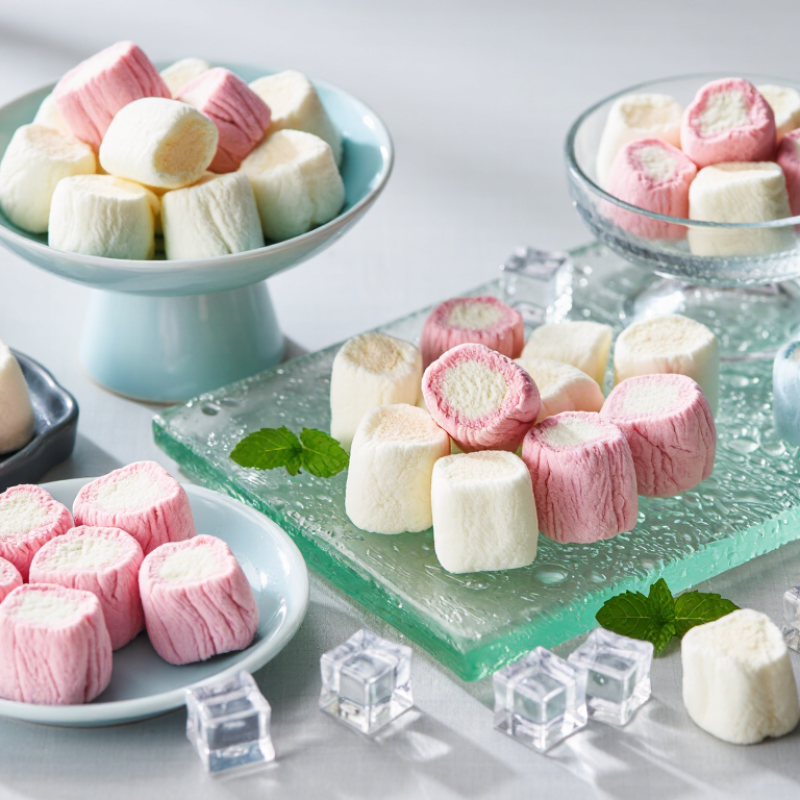
Ice marshmallows are soft marshmallow pieces designed for cold use, or freeze-dried versions that become light and crisp. The term is not fully standardized worldwide. Some suppliers describe chilled, ice-cream-filled centers, while others mean dehydrated marshmallow bites. Buyers should request product specifications before comparing quotations. Texture, moisture content, filling stability, and storage temperature can vary sharply.
Their popularity comes from contrast. A cold dessert can combine a soft outer layer with a quick, creamy center. Freeze-dried pieces add a delicate crunch to cocoa, cereal, milkshakes, and dessert toppings. They also create visible texture in clear cups and colorful snack mixes. That visual effect matters in international foodservice. It makes a simple serving look more carefully prepared.
Market data supports the wider opportunity. Grand View Research valued the global freeze-dried food market at about USD 2.9 billion in 2023, with continued growth projected through 2030. Innova Market Insights has repeatedly identified texture and multisensory eating as important global food-development themes. These reports do not measure ice marshmallows directly. That limitation matters. The category is still fragmented, and definitions differ by region. Experienced buyers should inspect water activity, ingredient declarations, allergen controls, packaging seals, and cold-chain requirements. A product that looks perfect in a sample box may soften during humid shipping. Small tests are wiser than confident assumptions.
Key Criteria for Evaluating Ice Marshmallow Suppliers
2026 Best Ice Marshmallow Suppliers for Global Buyers?
Choosing an ice marshmallow supplier requires more than comparing prices. Product consistency matters across shipping seasons, climates, and storage conditions. Request production samples from different batches. Check texture, shape, color, moisture, and melting behavior after freezing and thawing. A reliable supplier should explain its recipe controls and cold-chain process clearly.
Review food-safety certifications, laboratory reports, allergen controls, and traceability records. Confirm whether testing covers microbiological safety, additives, packaging materials, and shelf life. Documents should include issue dates and matching batch numbers. Ask how the supplier handles temperature deviations during transport. A delayed shipment can change texture, even when the package looks undamaged. Delivery performance also deserves evidence, not promises. Contact recent business references when possible. Some suppliers provide excellent samples but weaker routine production. That gap deserves attention.
Tips: Start with a small trial order. Measure arrival temperature immediately. Photograph damaged cartons and record storage conditions. Confirm packaging language, pallet limits, customs documents, and destination requirements before contracting. Avoid judging quality from one sample alone. A second review may reveal inconsistency. Discuss lead times, minimum order quantities, replacement policies, and communication hours in writing. Prices can change, so request a validity period for every quotation. Local rules may differ, and supplier documents do not replace your own compliance review.
Leading Ice Marshmallow Supplier Regions and Market Profiles
2026 Best Ice Marshmallow Suppliers for Global Buyers?
Leading Ice Marshmallow Supplier Regions and Market Profiles
Ice marshmallow sourcing is expanding across North America, Europe, East Asia, and Southeast Asia. However, customs data rarely isolates marshmallows. The International Trade Centre classifies them under HS 1704, covering sugar confectionery without cocoa. This limits precise supplier comparisons. Buyers should inspect factory records, cold-chain capacity, and moisture-control procedures.
North American producers often offer large-scale output, automated depositing, and stable packaging systems. European suppliers typically emphasize clean-label recipes, reduced additives, and premium seasonal formats.
East Asian factories are strong in compact packaging, texture innovation, and convenience retail. Southeast Asia provides competitive labor costs and growing export infrastructure. USDA Foreign Agricultural Service reports continued high global sugar consumption, supporting broad confectionery production, but raw material prices remain unpredictable.
Cold storage changes the buying decision. Ice marshmallows can soften, deform, or absorb odors during transit. A practical supplier audit should test texture after repeated temperature changes. Not every attractive sample survives shipping. This is where inexperienced buyers can lose money. Intertek and SGS food-testing guidance commonly emphasizes microbiological controls, allergen management, traceability, and documented shelf-life validation. Certifications matter, but paperwork alone proves little. Ask for recent batch results, packaging specifications, and evidence from comparable export orders before signing a long-term agreement.
How Global Buyers Can Compare Quality, Pricing, and Certifications
2026 Best Ice Marshmallow Suppliers for Global Buyers?
Global buyers should compare ice marshmallow suppliers through samples, records, and repeatable testing. Check shape retention after freezing, thawing, and short exposure to room temperature. The surface should remain clean, while the center keeps a soft, stable texture. Ask for batch specifications covering ingredients, allergens, moisture, weight tolerance, and shelf life. A sample may look excellent, yet perform poorly after ocean transport. Test it under realistic conditions.
Price comparisons need more than the unit quotation. Review minimum order quantities, packaging costs, temperature control, insurance, duties, and delivery terms. A lower factory price can become expensive after damaged cartons or delayed customs clearance. Request a clear cost sheet. Compare equal specifications, not attractive numbers. Payment flexibility also matters for smaller buyers.
Certification documents should be current, verifiable, and linked to the actual production site. Look for recognized food-safety systems, allergen controls, traceability procedures, and recent laboratory reports. Ask how quickly the supplier can identify affected batches. Factory audits, video inspections, and production photos add useful evidence, but they are not perfect substitutes for independent checks. I would still order a small trial shipment before signing a long contract. That step can feel slow. It often exposes weak seals, uneven sizing, or unclear labeling. Reliable suppliers should explain corrective actions without avoiding difficult questions.
2026 Best Ice Marshmallow Suppliers for Global Buyers
A practical comparison framework for evaluating quality, pricing, certifications, and international logistics without relying on company or brand names.
The chart shows the number of evidence items buyers should compare in each category. Quality covers specifications, ingredients and allergens, microbiological COAs, shelf-life validation, and batch traceability. Certification checks include certificate validity, scope, audit status, and corrective-action records. Pricing should be compared by unit basis, MOQ, Incoterms, and payment terms, while logistics includes lead time, temperature-control capability, packaging, and export documentation.
Import, Packaging, and Logistics Considerations for Ice Marshmallows
For global buyers, the best ice marshmallow suppliers in 2026 should prove more than production capacity. They need stable recipes, documented food controls, and experience with frozen exports. Ask for recent batch records, allergen statements, ingredient specifications, and independent laboratory results. Request samples from different production dates. One attractive sample proves very little.
Packaging must protect texture, flavor, and temperature. Individual wrapping can reduce moisture transfer, while strong outer cartons prevent crushing during handling. Insulated liners and suitable refrigerants may be necessary for long routes. The supplier should state the required storage temperature, shelf life, carton dimensions, and pallet limits clearly. Cold-chain discipline matters. A tiny temperature gap can damage a full shipment.
Import planning should include commercial invoices, packing lists, product labels, certificates, and destination-country food requirements. Confirm whether the product travels frozen, chilled, or under controlled conditions before booking freight. Use a logistics provider that can provide temperature records and delivery alerts. I would also test one small shipment before scaling purchases. Mistakes happen. A supplier may promise fast loading but overlook port delays or weekend customs clearance. Buyers should review insurance coverage, backup packaging, and emergency contact procedures. The lowest unit price is rarely the lowest landed cost. Reliable communication, traceable batches, and realistic delivery estimates usually protect margins better.
